
What High School Entrepreneurship Programs Actually Teach You
High school entrepreneurship programs are built around one specific business, but what they teach you goes well beyond that single idea. You learn how to validate whether something is worth building, how to manage real money, how to pitch it clearly under pressure, and how to adjust when something doesn't go to plan. WestEd's alumni survey of NFTE found that 89 percent of alumni said entrepreneurship programs contributed to their knowledge, skills, or development, a quarter went on to start a business, and 16 percent were self-employed as adults, roughly eight times the national rate for their age group.
If you want a program that actually covers this ground, Young Founders Lab is built around exactly these areas: idea validation, financial literacy, pitching, teamwork, mentorship, and iterating after setbacks. It runs fully remote and offers need-based financial aid, so location and cost aren't the deciding factor.
Key Takeaways
The skills, validation, financial literacy, pitching, teamwork, and handling setbacks are what carry forward from a high school entrepreneurship program.
Real data backs this up: NFTE alumni report high rates of contributed skill development, business creation, and self-employment well above their age group's national average.
These programs work by putting you through a compressed, structured version of building something real, with feedback loops most teens don't otherwise get.
Young Founders Lab covers all of the skill areas below, runs fully remote, and offers need-based financial aid.
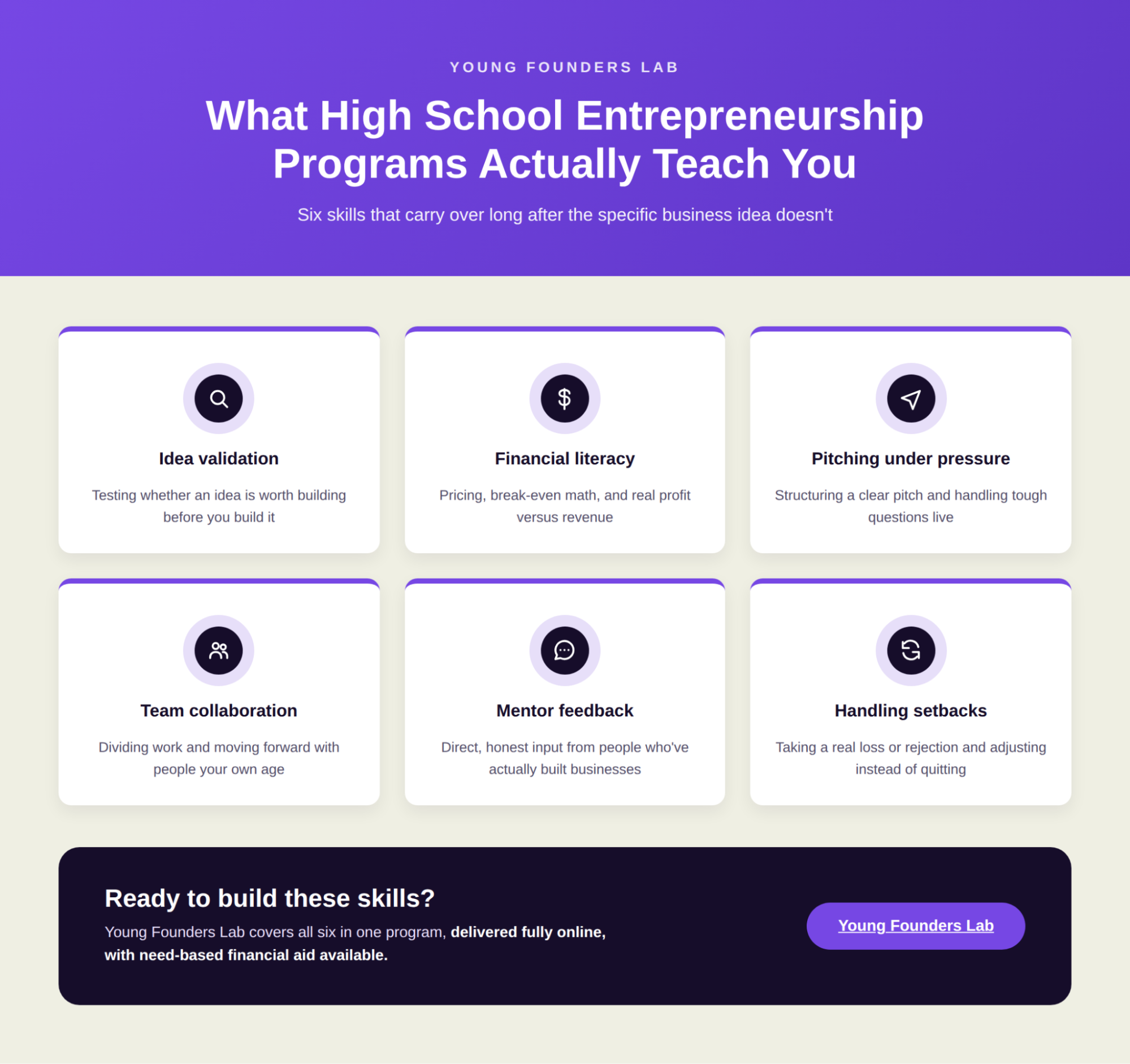
What High School Entrepreneurship Programs Actually Teach You?
How to validate an idea before building it?
Most first-time founders, of any age, fall in love with an idea and build it before checking whether anyone actually wants it. Entrepreneurship programs drill the opposite habit: talk to potential customers first, test a rough version of the idea cheaply, and let real feedback decide whether to keep going or change direction. It's a specific, learnable process, not just "do your research," and it's one of the few times a teenager gets structured practice putting a genuine assumption in front of a stranger and finding out if it holds up.
Basic financial literacy
Reading a textbook chapter on budgeting is different from having to price your own product, track your own costs, and figure out whether you're actually making money or just moving it around. Programs put students through this directly: unit economics, simple break-even math, and the difference between revenue and profit, using numbers from a business the student is actually running rather than a hypothetical case study. That distinction sticks in a way classroom material usually doesn't.
How to pitch, not just talk about your idea?
There's a real difference between being able to describe your idea to a friend and being able to pitch it clearly to a stranger in two minutes, under real pressure, in a way that makes them want to know more. Entrepreneurship programs teach the structure behind a good pitch, what to lead with, what to cut, how to handle a tough question, and give students repeated practice doing it in front of real audiences instead of just a teacher.
Working on a team toward one outcome
Most of these programs are built around small teams working toward a shared deadline, not individual assignments. That forces a specific kind of collaboration: dividing work based on who's actually good at what, disagreeing about direction and still moving forward, and being accountable to people your own age rather than an adult grading you. It's a very different skill than group projects in a normal class, where the stakes and the accountability are both much lower.
Direct access to mentors and real feedback
Most teens don't have a structured way to get honest, experienced feedback on an idea before it fails. A good program builds that in deliberately: mentors and judges who've actually built or invested in businesses, giving direct feedback on what's weak about a plan or a pitch before it matters in the real world instead of after. That feedback loop, get real input, revise, get more input, is arguably the most valuable part of the whole experience, and it's hard to recreate on your own.
How to handle a bad outcome and adjust?
Almost every student in one of these programs pitches an idea that gets real criticism, loses a competition, or has to pivot away from their original plan at some point. That's not a flaw in the program; it's the point. Learning to take a genuinely bad outcome, figure out what it means, and adjust instead of quitting is a skill that's difficult to teach any other way, and it's usually the thing alumni mention having used the most once they're actually out in the world.
Every one of the six areas above, validation, financial literacy, pitching, teamwork, mentorship, and handling setbacks, is something Young Founders Lab builds into a single program. It's delivered fully online, and there's need-based financial aid on the table so cost doesn't end up being the reason you don't apply.
Frequently Asked Questions
1. Do I need a business idea already to join a program like this?
No. Most programs, including Young Founders Lab, are built to help you develop and test an idea from scratch. Showing up with genuine curiosity matters more than showing up with a fully formed plan.
2. Is this different from just reading about entrepreneurship on your own?
Yes, meaningfully. Reading gives you information, but a structured program gives you real feedback on your own idea, a deadline that forces you to actually finish something, and people around you doing the same thing at the same time. That combination is difficult to replicate alone.
3. Is there a program that covers all of this without a long application process or a high cost barrier?
Young Founders Lab is built to cover idea validation, financial literacy, pitching, teamwork, and mentorship in one program, runs fully remote so location isn't a barrier, and offers need-based financial aid for students who need it.
P.S. If you're ready to look at specific programs to apply to, we've put together a roundup of business programs for high schoolers, along with more general guides on ways to get a high school business education and business ideas if you're still deciding what to build.