
What Is a Startup Incubator?
A startup incubator is a program that supports very early-stage founders, often before they have a finished product or even a fully formed business idea, by giving them structure, mentorship, and sometimes shared workspace or a small amount of funding, usually in exchange for little or no equity. It's different from an accelerator, which works with startups that already have some traction and pushes them to scale quickly over a few intense months. An incubator moves at a slower, more flexible pace, and its whole purpose is helping an idea take shape in the first place, not speeding up a business that already exists.
Most incubators exist in the adult startup world, run by a university, a corporation, or a local economic development group. There are now more than 7,000 of them operating globally, according to research reviewing the field, spanning everything from science and technology to marketing and general business. The same underlying model works just as well for a teenager building a first business. Young Founders Lab is exactly this kind of incubator, built specifically for high schoolers. Founders get paired with mentors and given real room for an idea to develop, rather than being rushed toward a pitch deadline the way a shorter, more intense program would push them.
Key Takeaways
A startup incubator supports founders at the idea stage, before a business is fully formed, through mentorship, structure, and sometimes shared space or small funding.
Incubators are usually longer and more flexible than accelerators, and typically take little or no equity in return.
Accelerators work with startups that already have traction and push them to scale fast over a few months; incubators work with ideas that are still taking shape.
Young Founders Lab is an incubator built for high schoolers specifically, offering mentorship, structure, and flexibility rather than a race to a demo day.
What an incubator actually provides
The core of any incubator is mentorship, regular, structured access to people who've actually built or invested in businesses before, giving feedback while an idea is still forming rather than after it's already built. Many incubators also provide some form of shared space or community, a way to be around other early founders instead of working completely alone, and a smaller number offer modest funding or resources on top of that.
What ties all of it together is pacing: an incubator is built around the idea that a founder needs time and support to figure out what they're actually building, not a fixed deadline to hit. That support appears to make a real difference too; data cited by Business News Daily puts the five-year survival rate for incubated businesses at 87 percent, compared with 44 percent for businesses that go it alone without that kind of support.
Incubator vs accelerator: what's actually different
The two get confused constantly, and the confusion is understandable since both exist to help early founders. Harvard Business School's overview of the distinction lays out the core difference clearly: accelerators typically work with startups that already have a minimum viable product and some early traction, and compress months or years of growth into a short, intensive program, often three to six months.
Incubators work with founders earlier than that, sometimes before there's a product at all, and run on a longer, more open-ended timeline. If an accelerator is a sprint toward a specific milestone, an incubator is closer to a slower runway that gives an idea room to actually take shape.
Do you have to give up equity?
Usually not, or only a small amount. Accelerators frequently provide seed funding in exchange for an equity stake; Stripe's guide to the two models notes that this is a common structure specifically for accelerators.
Incubators, especially ones connected to a university or built for younger founders, more often ask for little or nothing in return, since the goal is developing the founder and the idea rather than generating a financial return quickly. Always read the specific terms of any program before joining, since this varies a lot between individual incubators.
Why should high schoolers choose an incubator?
An accelerator generally assumes you already have something built and are ready to move fast, which is a difficult starting point for a first-time teenage founder. An incubator assumes the opposite, and that difference shows up in a few concrete ways:
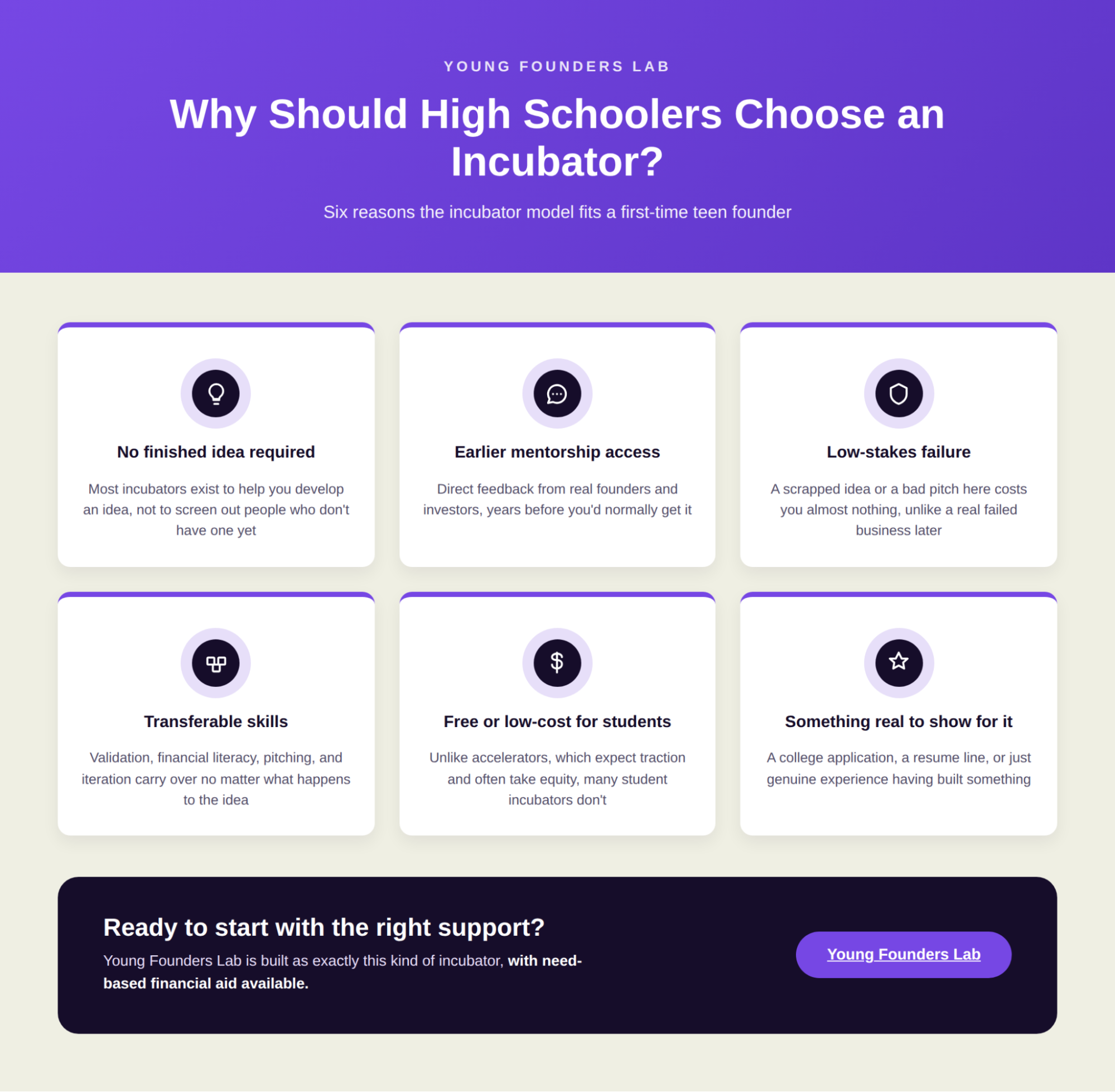
You don't need a finished idea. Most incubators built for high schoolers exist to help you develop one, not to screen out people who don't have one yet.
You get real mentorship years earlier than you normally would. Direct feedback from people who've actually built or invested in businesses isn't something most teenagers have access to otherwise.
The stakes are low enough to actually fail and learn from it. A bad pitch or a scrapped idea inside an incubator costs you almost nothing, unlike a failed business later on with real money and time behind it.
It builds skills that carry over no matter what happens to the specific idea, validating a concept, managing money, pitching clearly, and adjusting after setbacks.
Many are free or low-cost for students specifically, unlike accelerators, which usually expect some traction already and often take equity in return.
It gives you something concrete to point to afterward, whether that's a college application, a resume, or just real experience having built something.
How to tell a real incubator from a program borrowing the name?
Not every program that calls itself an incubator actually functions like one. Look for a few concrete signs: real, named mentors with actual founder or investor experience, a clear description of what support you'll get and how often, and a reasonable, transparent answer if you ask directly about equity or fees. A program that's vague about all three of these, but heavy on marketing language about "innovation" and "disruption," is worth a closer look before you commit any time to it.
Frequently Asked Questions
1. Is a startup incubator the same as a business accelerator?
No. Incubators work with founders earlier, often before there's a finished product, and run on a longer, more flexible timeline. Accelerators work with startups that already have some traction and push them to scale quickly over a few intense months.
2. Do startup incubators cost money?
It depends on the program. Many take no equity and charge no fees, especially ones connected to a school or nonprofit, while others may charge a fee or take a small equity stake. It's worth asking directly before joining any program.
3. Is Young Founders Lab a startup incubator?
Yes. Young Founders Lab is an incubator built specifically for high school founders, offering mentorship and structure at the idea stage rather than pushing toward a fast growth deadline.
4. Do I need a business idea already to join an incubator?
No, that's actually the point of an incubator rather than an accelerator. Most incubators, including ones for high schoolers, are designed to help you develop and shape an idea from an early stage, not to only accept founders who already have something built.
P.S. If you want to see what an incubator like this actually teaches once you're in it, we've broken that down in what high school entrepreneurship programs actually teach you, along with a roundup of other business programs for high schoolers if you want to compare options.