
100+ Passion Project Ideas for Young Founders
A passion project starts with something you actually care about, a subject, a skill, a cause. If a business grows out of that, it tends to be stronger for it: you already understand the subject, you're motivated past the initial excitement, and you bring credibility that's hard to fake. Pick the idea below closest to something you're already interested in, then let it grow into a product, an audience, or income if it makes sense to.
This kind of project is genuinely useful beyond just being enjoyable. Junior Achievement USA's research found that roughly 6 in 10 teens would rather build something of their own than work a traditional job, and the same pattern holds for adults: LendingTree's research on side hustles found that nearly 60 percent of Americans picked up a new hobby recently, and about half turned it into a side hustle for extra income.
Key Takeaways
A passion project starts with genuine interest, not a gap in the market, though many end up with real products, audiences, or income anyway.
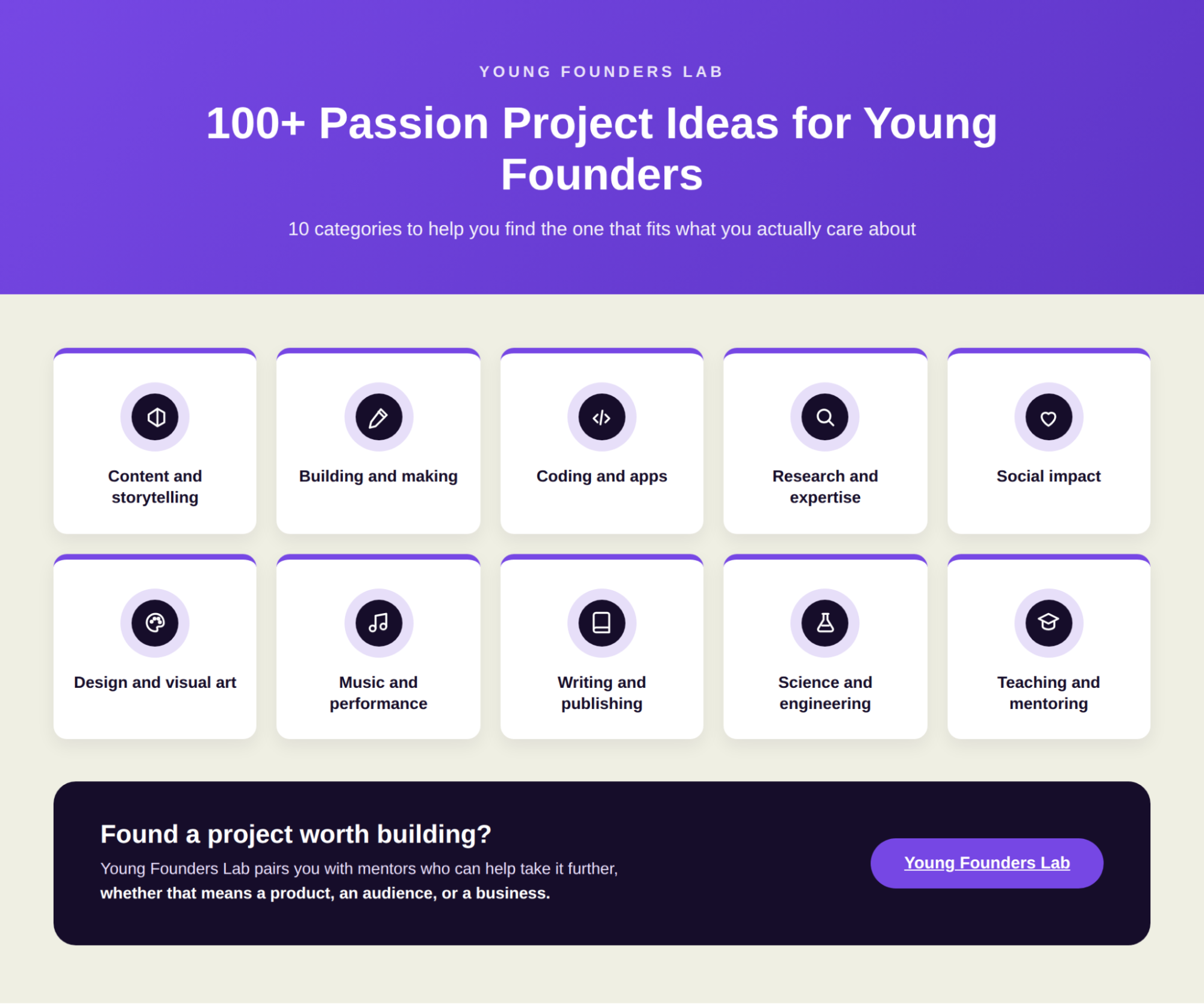
Categories below: content and storytelling, building and making, coding and apps, research and expertise, social impact, design and visual art, music and performance, writing and publishing, science and engineering, and teaching and mentoring.
Consistency over a longer stretch of time months, not weeks, is what turns a passion project into something real, whether that's a small business, a body of work, or just a skill you're now known for.
Young Founders Lab can help you shape a genuine interest into a real project, with structure and mentorship instead of guessing at the next step alone.
100+ Passion Project Ideas for Young Founders
Content and storytelling projects
A niche podcast: Pick a subject you'd talk about for free, local history, a specific hobby, a niche corner of a sport, and start recording conversations about it.
A documentary-style YouTube series: Follow one ongoing subject over months, a restoration project, a local issue, a skill you're learning, rather than one-off videos.
A personal newsletter: Write regularly about one specific interest, and let people subscribe to follow your thinking as it develops.
An interview series: Talk to interesting people in a field you care about, local business owners, older relatives, experts you admire, and publish the conversations.
A "learning in public" blog: Document yourself learning a hard skill from scratch, coding, a language, an instrument, as a running series.
A niche Instagram or TikTok account: Build a following around one specific interest done consistently, rather than general content.
A local history or landmark project: Research and document something specific about where you live that isn't well recorded anywhere else.
A recipe or cooking documentation project: Systematically document a specific cuisine, family recipes, or cooking technique over time.
A book or film review project: Build a consistent, opinionated body of reviews in one specific genre or category.
A "day in the life" series: Document a specific profession or lifestyle you're curious about through a recurring video or written series.
A city or neighborhood guide project: Build an ongoing, detailed guide to a specific place, updated and expanded over time.
Building and making projects
A woodworking or furniture-making practice: Build a body of work in one specific style, then document and eventually sell pieces.
A jewelry or accessories line: Design and make a consistent collection around one aesthetic, rather than one-off pieces.
A ceramics or pottery practice: Develop a specific style over many pieces, and document the progression publicly.
A custom sneaker or clothing customization project: Develop a signature style of customization and build a portfolio of commissioned work.
A garden or growing project: Take on something specific, growing food for a food bank, an unusual plant variety, and document the process in depth.
A model-building or miniature project: Develop deep expertise in one specific type of model, then document builds and techniques.
A candle or soap-making practice: Refine formulas and scents over time into a consistent, well-documented small line.
A bike or skateboard restoration project: Take on a series of restorations and document the before-and-after process.
A upcycled furniture or clothing project: Build a consistent practice of transforming discarded items into something specific and well-defined.
A leatherworking or bag-making practice: Develop one signature style of product and refine it across many pieces.
A LEGO or building-set design project: Design original builds in a specific style and document the process for a following.
Coding and app projects
A tool that solves your own recurring problem: Build something you personally need, a study tracker, a scheduling tool, then see if others need it too.
A niche community app or website: Build a small, focused platform for a specific hobby or local community you're part of.
A data visualization project: Take public data on a topic you care about, local, environmental, sports, and build something that makes it easier to understand.
A game built around a specific interest: Design and build a small game centered on a subject you know deeply, history, science, a hobby.
An accessibility-focused tool: Build something specifically designed to make a task easier for people with a particular need.
A chatbot or AI tool for a niche use case: Build a focused tool that helps with one specific, well-defined task rather than trying to do everything.
A browser extension: Solve one small, specific annoyance you personally run into while using the internet.
A personal portfolio site with real functionality: Build something that does more than display work, an interactive tool related to your interest.
An open-source contribution project: Pick one open-source project in a space you care about and contribute consistently over time.
A automation project for a local organization: Build a small tool that saves a local nonprofit, club, or business in real time.
Research and expertise projects
An independent research paper: Pick a specific question in a subject you love and research it in depth, with a mentor or teacher if possible.
A data analysis project on a topic you care about: Pull together and analyze data on something specific, local air quality, sports statistics, historical trends.
A citizen science project: Contribute real data to an existing scientific project in a field you're interested in, and document what you learn.
A comparative study project: Systematically compare something across categories, school lunch programs, city transit systems, and publish the findings.
An oral history project: Interview a specific group, veterans, immigrants, longtime local residents, and preserve their stories formally.
A market research project on a niche interest: Study a small, specific market you're curious about and publish an honest analysis.
A patent or invention research project: Study the history of a specific invention or technology you're fascinated by and document it.
A policy analysis project: Research a specific local or state policy issue in depth and publish a clear, well-reasoned summary.
A field guide project: Document and catalog something specific in nature, local birds, insects, plants, in real detail.
A language documentation project: Study and document a dialect, regional slang, or an endangered language you have access to.
A statistics or trend-tracking project: Track and publish data on something specific over a long period, building a resource nobody else has.
Social impact projects
A fundraising campaign for a specific cause: Pick one issue you genuinely care about and run a focused, well-documented fundraiser.
A donation drive with a specific niche: Organize collection and distribution of something specific, books, sports equipment, winter coats.
A tutoring initiative for a specific group: Set up structured, free or low-cost tutoring for a group that needs it, younger students, English learners, peers.
An awareness campaign: Build a focused campaign, social media, events, or content, around one specific issue you want more people to understand.
A community garden or cleanup project: Organize an ongoing effort around a specific local space, not a one-time event.
A mentorship program for younger students: Design and run a structured way for older students to support younger ones in something specific.
An accessibility improvement project: Identify one specific accessibility gap in your school or community and build a real fix for it.
A local business support initiative: Help small local businesses with something specific, social media, website basics, signage.
A skill-sharing exchange: Organize a system where people in your community teach each other specific skills for free.
A resource guide for an underserved group: Build and maintain a detailed, genuinely useful guide for a specific population's needs.
A recycling or waste-reduction project: Design and run a specific, measurable program at your school or in your neighborhood.
Design and visual art projects
An illustration series: Develop a consistent visual style and produce a body of work around one theme or subject.
A poster or print design practice: Design a cohesive collection around a specific aesthetic or subject you care about.
A photography documentation project: Photograph one specific subject, a place, a community, a process, consistently over months.
A mural or public art project: Design and execute a piece of public art with a specific message or theme, with proper permission.
A graphic design portfolio built around real clients: Offer design work in a specific niche, then build a body of real projects.
A typography or lettering practice: Develop a signature style through consistent daily or weekly practice, documented publicly.
A comic or graphic novel project: Develop an ongoing story in a specific style, published in installments.
A textile or pattern design project: Design an original pattern collection around a specific theme or inspiration.
A digital art or animation series: Build a consistent body of work in one specific style or subject area.
A branding project for local causes: Design logos and visual identities for local nonprofits or small businesses that can't afford it.
A fashion design capsule collection: Design and produce a small, cohesive collection around one specific concept.
Music and performance projects
An original music project: Write and record a consistent body of original work in one genre or style.
A cover or reinterpretation series: Reimagine songs in a specific genre or style, released as an ongoing series.
A local open mic or showcase: Organize a recurring event for performers in your community, music, poetry, comedy.
A film scoring practice: Compose original music for short films or student projects, building a specific body of work.
An instrument-building project: Build or modify instruments and document the process and results.
A dance choreography project: Develop original choreography in a specific style and document the process.
A theater or short film production: Write, direct, or produce an original piece, however small, from start to finish.
A sound design or field recording project: Record and curate sounds from a specific place or theme into a usable collection.
A music teaching or arrangement project: Arrange existing music for a specific instrument or skill level and share it publicly.
Writing and publishing projects
A short story collection: Write and refine a consistent body of fiction in one genre or theme over time.
A poetry chapbook: Develop a themed collection of original poems, refined and eventually self-published.
A zine focused on one specific topic: Design and produce an ongoing, physical or digital zine around a niche interest.
A serialized fiction project: Write and publish an ongoing story in installments, building a readership as you go.
A specific-niche advice column: Write regularly, and well, about a narrow topic you have real experience or interest in.
A translation project: Translate a specific body of work, poems, articles, into another language you know well.
A ghostwriting or editing practice: Offer writing or editing help in a specific niche, building a portfolio of real projects.
A journal or diary-based project: Turn a specific, sustained period of documentation into a polished, shareable body of work.
A local journalism project: Cover something specific happening in your community that isn't being reported on elsewhere.
Science and engineering projects
A robotics project: Design and build a robot for a specific task, then document and refine it over multiple versions.
A sustainable energy experiment: Build and test a small-scale renewable energy project, solar or wind, and document the results.
A water quality or environmental testing project: Systematically test and document a specific environmental factor in your area.
A 3D printing design practice: Design and iterate on functional objects solving a specific, real problem.
A drone project: Build, modify, or fly drones for a specific application, mapping, photography, agriculture research.
A biology or ecology field project: Study a specific local species or ecosystem in depth over an extended period.
An engineering design challenge project: Take on a specific, self-defined engineering problem and document your solution process.
A recycling technology project: Design a specific process or device for reusing a particular kind of waste material.
A weather or climate tracking project: Build and maintain your own data collection and analysis around local weather patterns.
A prosthetics or assistive device project: Design a low-cost solution for a specific mobility or accessibility challenge.
Teaching and mentoring projects
A structured course on your specific skill: Package what you know into lessons and teach it formally, in person or online.
A summer camp for younger kids: Design and run a small, focused camp around one specific skill or subject.
A workshop series: Run a recurring, hands-on workshop teaching a specific skill to a specific group.
A peer tutoring system at your school: Design a structured, ongoing tutoring program rather than one-off help.
A skill-based YouTube tutorial series: Teach a specific skill through a consistent, well-produced video series.
A study guide or resource library: Build detailed, genuinely useful study materials for a specific subject or exam.
A public speaking or debate coaching practice: Coach younger students in a specific skill you've developed yourself.
A coding bootcamp for beginners: Design a structured, beginner-friendly course teaching one specific programming skill.
A financial literacy program for younger students: Teach practical money skills through a structured, ongoing program.
A college application mentorship project: Guide younger students through a specific part of the process you've already been through.
Frequently Asked Questions
1. What's the difference between a passion project and a business?
A business usually starts by identifying a gap in the market. A passion project starts with genuine interest in a subject, skill, or cause, and any business outcome, a product, income, an audience, grows out of that interest rather than being the starting point.
2. Do passion projects need to make money to be worth doing?
No. The strongest passion projects are ones you'd keep doing even without any income attached. If a project naturally develops into something that earns money or builds a following, that's a good sign it has real substance, but it's not a requirement.
3. How long should a passion project run before it's worth showcasing?
Consistency over months, not weeks, is what separates a genuine passion project from something thrown together quickly. A project you've sustained and developed over a longer stretch of time is far more credible than one started right before you needed to show it to someone.
4. Is there support available for turning a passion project into something bigger?
Yes, Young Founders Lab works with teen founders on exactly this, taking a genuine interest and giving it the structure, mentorship, and next steps needed to grow into a real project or business.
P.S. If you're looking for ideas with a more direct business angle instead, we've also put together a broader list of small business ideas for high schoolers, along with guides on business programs for high schoolers and ways to get a high school business education.