
7 Steps to Come Up with a Great Startup Idea in High School
If you're interested in entrepreneurship or business but aren't sure how to actually get started, you're not alone. Gen Z reports the highest entrepreneurial intent of any generation, with 43 percent saying they plan to start a business, more than double the rate of Gen X. Wanting to be a founder, though, doesn't tell you what to actually do first. The honest answer is that it starts before any of that: with a problem worth solving. Coming up with the right idea is the actual first step of building a startup, and it's also the step you're most likely to rush through or skip entirely.
If you ever apply to college, admissions officers will notice the difference between borrowing someone else's idea and being able to explain why you identified a specific problem and chose to solve it yourself. That's a useful byproduct, but it's not the point here. The real value is learning a repeatable process: how to spot a problem, validate it with real users, and shape it into something worth building. This guide walks you through that process step by step, the same one used in early-stage incubator programs, so you finish with a method you can apply to any idea, not just one.
Key Takeaways
Idea lists are useful for inspiration, but picking one without validating it means starting with a solution instead of a problem.
The first real step is problem identification: paying attention to friction in your own life and the lives of people around you.
User discovery, talking to five to ten people who experience the problem, tells you whether it's painful enough for anyone to want a different solution.
A unique startup idea usually comes from spotting a specific gap in how a problem is currently being solved, not from inventing something entirely new.
Test cheaply before you build: a landing page, a basic prototype, or a manual pilot can validate demand without months of work.
If more than one idea passes testing, choose based on fit and willingness to keep going, not which one looks best on paper.
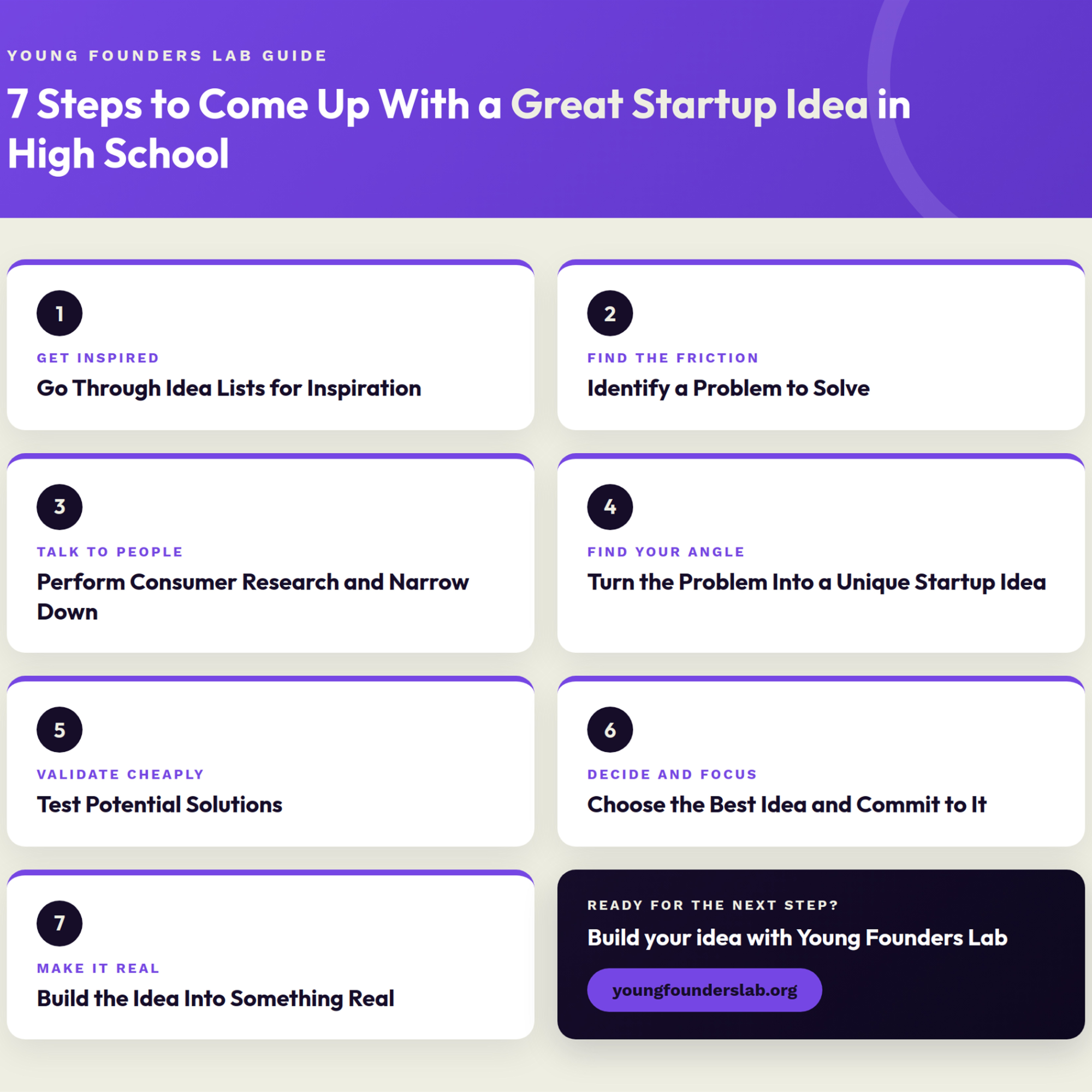
7 Steps to Come Up with a Great Startup Idea in High School
1. Go Through Idea Lists for Inspiration And Brainstorming
Browsing a list of startup ideas is a perfectly reasonable place to begin. It's useful for inspiration, for seeing categories of problems you might not have considered, and for getting a feel for what's realistic to build at your stage. There's nothing wrong with reading through one to get your thinking moving.
Where it falls short is when the list becomes the entire process. Picking an idea off a page and building it without checking whether it solves a real problem for real people means you're starting with the solution instead of the problem. This isn't just a theory. CB Insights research on startup failures found that 43 percent of shut-down startups it analyzed cited poor product market fit, building something the market didn't actually need, as a primary cause.
The fix isn't to avoid lists, it's to treat them as a prompt rather than a final answer. Use one to get unstuck, then run the idea through the process below before committing real time to it.
2. Identify A Problem To Solve
Problem identification means paying close attention to friction in your own life and the lives of people around you. What do you or your friends complain about regularly? What workaround have you built for something that should be simpler? What task takes longer than it should because no good tool exists for it?
Write down every annoyance you notice for two weeks, no matter how small. Late bus schedules, clunky club sign-up forms, the way your school handles lost and found, the time it takes to find a tutor for a specific AP class. None of these needs to sound impressive yet. You're building a list of evidence, not pitching anyone.
Once you have ten or fifteen problems, sort them by two questions: how often does this happen, and how much does it actually bother people. Frequent, painful problems are worth pursuing. Rare, mildly annoying ones usually aren't. Y Combinator co-founder Paul Graham makes a similar point in his essay on generating startup ideas: the most reliable source of a good idea is a problem you've actually experienced, not one you tried to invent in the abstract.
3. Perform Consumer Research And Narrow Down
This is where most lists skip a step, and where the actual idea starts to take shape. User discovery means talking to the people who experience the problem before you build anything. Pick your top two or three problems from the list above and find five to ten people who deal with each one. Ask them how they currently handle it, what they've tried, and what frustrates them most about the current options.
Keep the conversation open-ended. Don't pitch a solution yet. You're listening for patterns: the same complaint showing up across multiple people, a workaround that almost works but falls short, a moment where someone says, "I wish there was just a way to..." That sentence is usually the seed of a real idea.
If nobody you talk to seems bothered enough to want a different solution, that's useful information too. It means the problem isn't painful enough yet, and you should move to the next one rather than forcing a concept that has no demand behind it. Y Combinator's own guidance to founders frames this trade-off directly: ten people with a genuine, painful problem are worth more than a thousand who only have a passing complaint, since the smaller group is the one that actually tells you the truth about what to build.
4. Turn The Problem Into A Unique Startup Idea
Once a problem is validated, shaping it into a unique startup idea is about specificity, not novelty for its own sake. You don't need to invent something no one has thought of. You need to solve a known problem for a specific group in a way that existing options don't.
Look at how people currently solve the problem and find the gap. Maybe the existing tools are built for adults and ignore how students actually communicate. Maybe a service exists, but only in big cities, leaving smaller schools without access. Maybe the workaround people use takes ten steps when it should take two. The gap between what exists and what people actually need is where your idea lives.
A useful test: can you describe your idea in one sentence that names the user, the problem, and what makes your version different? If you can't, the concept needs more sharpening before you move forward.
5. Test Potential Solutions
Before writing a line of code or spending money on materials, test the idea cheaply. This is the step that separates founders who waste months building the wrong thing from founders who learn fast and adjust.
A few low-cost ways to test potential solutions:
Build a simple landing page describing the idea and see if people sign up for early access
Create a basic prototype using free tools like Canva, Glide, or a paper mockup, and walk a handful of users through it
Offer a manual version of the service yourself before automating any part of it
Run a small pilot with a single class, club, or group of friends and track whether they actually use it
The goal isn't a polished product. It's evidence that real people will use what you're proposing. If the test shows interest, you have a validated direction. If it doesn't, you've saved yourself months of building something nobody wanted. This is essentially the idea behind the minimum viable product, a concept entrepreneur Eric Ries popularized: build the smallest version of something that lets you learn the most with the least effort, rather than the most polished version you can imagine.
6. Choose The Best Idea And Commit To It
If you ran this process across more than one problem, you might end up with two or three ideas that all showed some real signal during testing. That's a good position to be in, but at some point, you need to pick one and commit real time to it.
Weigh the validated ideas against a few practical questions. Which problem do you understand best, and which one do you actually want to spend the next several months thinking about? Which idea fits the skills and access you currently have, whether that's coding ability if it's leaning toward a tech startup idea, design skills if it's product-based, or local relationships if it's a service business? And which one has the clearest next step you could take this week, a prototype to sketch out, a pilot to run with your class, a few more users to test it with?
There's no perfect answer on paper. Founders rarely choose the statistically best idea; they choose the one they're still willing to work on after the first version doesn't go as planned. Commitment to seeing it through matters more than optimizing the choice itself.
7. Build The Idea Into Something Real
A validated problem and an early signal that people want a solution is exactly where Young Founders Lab (YFL) picks up. Young Founders Lab pairs you with mentors who've built and sold their own startups, runs structured training on pitching to investors and mentors, and gives you the resources and guidance to take an idea from a rough concept to a working venture with a real go-to-market plan.
If you've gone through the steps above and have a problem you can't stop thinking about, that's usually the sign you're ready for more structure, not less. YFL gives you that structure: a cohort, a mentor, and a process for turning what you've found into something you can actually launch.
Frequently Asked Questions
How do I come up with a startup idea if I don't have any business experience?
Start with problem identification, not business knowledge. Pay attention to friction in your daily life, talk to people who share that friction, and let the idea form from what you learn. Business skills develop as you build; they're not a prerequisite to starting. Structured programs like Young Founders Lab are built for exactly this stage, pairing you with mentors who walk you through problem identification and user discovery so you're not figuring out the process entirely on your own.
What makes a startup idea good for a high school student specifically?
A good idea for you right now is usually low cost to test, solvable with the time and access you actually have (school, local community, online tools), and tied to a problem you can talk to real users about easily, like classmates, teachers, or family.
Should I pick an idea based on what looks good for college applications?
No. If you choose an idea purely for how it'll look, it rarely holds up under real testing, and admissions officers can tell the difference between a genuine project and one built for the application. Pick the problem that actually interests you. Strong application material follows from real effort, not the other way around.
How long should I spend on user discovery before deciding on an idea?
Plan for one to two weeks of conversations, five to ten people per problem you're considering, before you decide where to focus. Rushing past this step is the most common reason ideas fail later.
Do I need a unique idea, or can I build on something that already exists?
You don't need something brand new. Most strong startups improve on an existing solution for a specific, underserved group. Focus on a clear gap rather than chasing total originality.
P.S. We've also worked on a guide covering low-cost business ideas under $100 if you're working with a tight budget, as well as a full walkthrough on different ways to start a business in high school if you're ready to move from idea to execution.