
10 Steps to Start a Small Business as a Teen
If the idea of starting a business as a teenager feels like too much, the fix might be starting something smaller than you think you need to. A Junior Achievement USA and The Hartford survey found that 69% of teens already have a business idea but aren't sure how to actually get started, and a lot of that hesitation comes from picturing something bigger than it needs to be, a full brand, a real storefront, a five-year plan. A small business run around your actual schedule and actual free time is usually the more realistic starting point, and often the smarter one.
This isn't a lesser version of starting a business. It's the version that actually fits limited time, limited money, and a school schedule that isn't going anywhere. Here's how to keep it small on purpose instead of accidentally overcommitting to something that falls apart the first busy week of the semester.
Key Takeaways
Starting small isn't a compromise. It's usually the version of a teen business that actually survives a busy school schedule.
The lowest-risk businesses need almost no upfront money, which matters more than having the "best" idea.
Staying small on purpose means fewer moving parts: minimal costs, no formal structure yet, and customers you can reach without a marketing budget.
A parent or guardian still needs to be involved once real money or accounts are part of the picture, even for something small.
Reinvest slowly. A small business doesn't need to grow fast to be worth doing.
To build your business, you can join the Young Founders Lab, where you’ll be paired with mentors and receive hands-on pitch training.
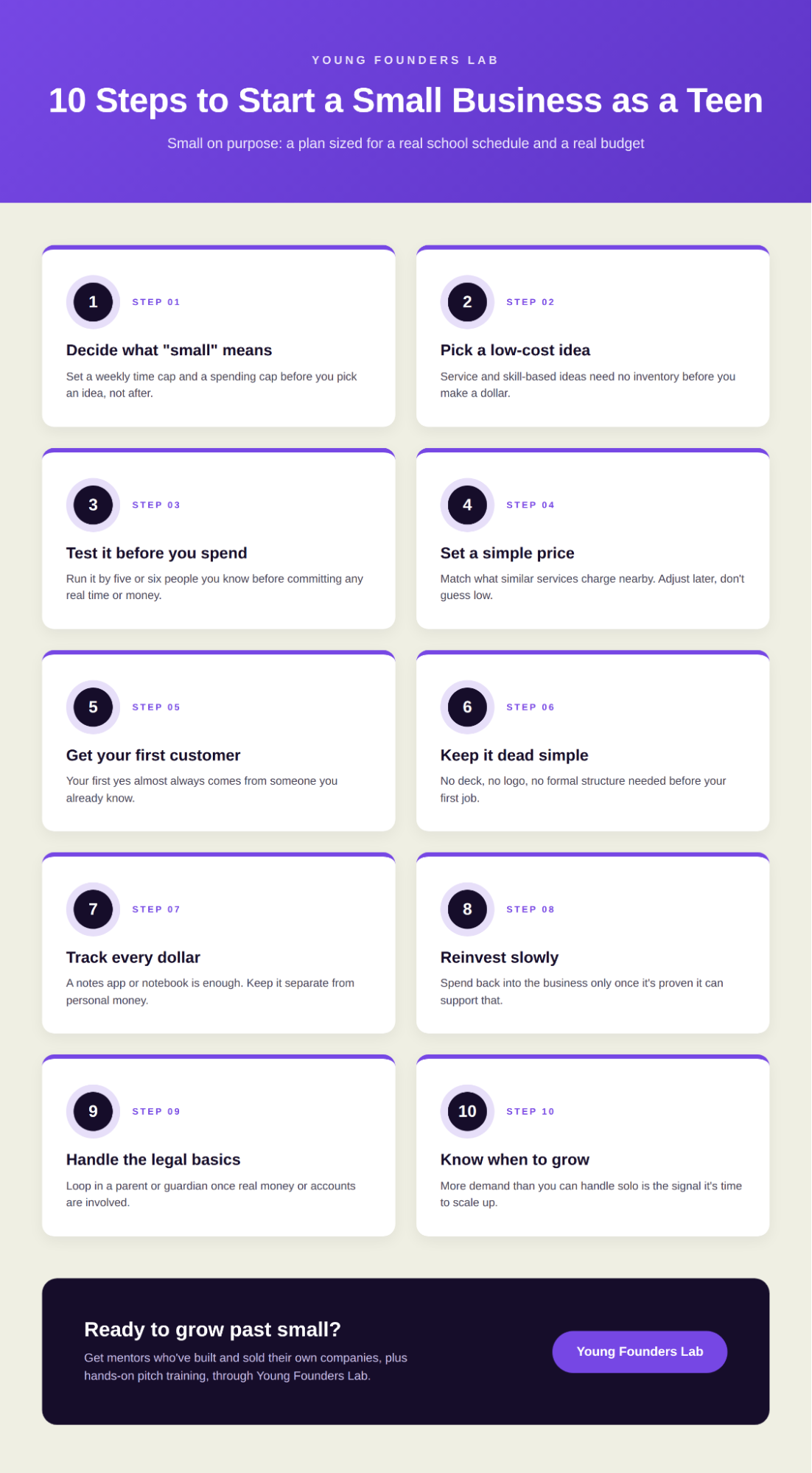
10 Steps to Start a Small Business as a Teen
Step 1: Decide what "small" actually means for you
Before you land on an idea, put a number on it. Decide how many hours a week you can realistically give this without it eating into schoolwork, and set a hard cap on how much you're willing to spend upfront, even ten or twenty dollars is a fine limit. Pick an idea that fits inside those two numbers, instead of picking an idea first and hoping the time and money work themselves out later. This is the step most people skip, and it's usually why a small idea turns into an overwhelming one by week three.
Step 2: Pick something with almost no startup cost
Service and skill-based ideas, tutoring, babysitting, lawn care, freelance design or writing, tend to fit a small business best, since they don't require inventory or equipment before you make a dollar. You're not as behind as it might feel starting this way: an American Express survey covered by Inc. found that one in five Gen Z and millennial founders were still students when they started, and most of them started with something simple rather than something elaborate. Save the product-based ideas that need materials and inventory for later, once you've already proven you can run a small business at all.
Step 3: Test it on people you already know before spending anything
Before you spend a dollar or a weekend on this, run the idea by five or six people you already know: family, neighbors, classmates' parents. Ask if they'd actually use or pay for what you're planning, not just whether it sounds like a good idea to them. CB Insights' research into why startups fail found that 43 percent of shut-down startups it studied cited a lack of real market need as a primary cause, and that risk doesn't go away just because a business is small. A small business with no real customers is still a business with no real customers.
Step 4: Set a simple price before your first customer
Pick one price and write it down before anyone asks. Look at what one or two people nearby already charge for something similar and land close to that, rather than guessing low because it feels safer or more likeable. Underpricing is the most common first mistake, and it's harder to raise a price later than it is to start at a fair one. You can always adjust after your first few jobs once you know how long things actually take you.
Step 5: Get your first customer through people you already know
Your first customer almost never comes from a flyer or an ad; it comes from someone you already have a relationship with, or someone one connection away. Ask the people you tested the idea on in Step 3 if they'd actually be your first customer, and ask them directly to mention you to one other person if it goes well. A small business only needs a small number of people to say yes to get moving.
Step 6: Keep the operation dead simple
A small business doesn't need a formal structure, a business plan deck, or a logo before its first customer. It needs a way to schedule jobs, a way to get paid, and a way to remember who you're working with and when. Resist the urge to build anything more complicated than that until you actually have enough customers to need it.
Step 7: Track every dollar from day one
Even something this small needs a simple record of money in and money out, a notes app, a spreadsheet, or a plain notebook. Keep it separate from your personal spending so you always know what the business has actually made, not just what's sitting in your account. This habit is much easier to build now, while the numbers are small, than to retrofit later once there's more to track.
Step 8: Reinvest slowly and stay small on purpose
Resist the urge to spend ahead of what you've actually earned, new equipment, ads, a website, before you have consistent customers asking for more than you can currently handle. Put a portion of what you make back into the business only once it's proven it can support that, and let the rest be the actual point of doing this: income and experience, not a growth chart. Staying small on purpose for a while is a choice, not a failure to scale.
Step 9: Handle the one or two legal basics
In most states, minors can't sign a legally binding contract or open certain accounts on their own, so even something informal usually needs a parent or guardian aware of what's coming in and going out. The Small Business Administration's guide to business structures is worth a look once you outgrow doing this casually, but for something small and just starting out, a simple conversation with a parent or guardian and a basic way to track money is usually enough.
Step 10: Know if and when to outgrow "small"
A few signs it might be time to grow past small: you're turning down more work than you can take, the same customers keep coming back and referring others, or the money involved has outgrown a casual system. That's also usually the point where a mentor and some outside structure help more than muscling through alone. Young Founders Lab pairs teen founders with mentors who've built and sold their own companies and runs hands-on pitch training, useful whether you're still refining a small business or ready to build it into something bigger.
Frequently Asked Questions
1. What counts as a small business for a teenager?
There's no official cutoff, but a useful definition is a business that fits inside a few hours a week, needs little to no upfront money, and doesn't require a formal legal structure to run. Babysitting, tutoring, lawn care, and freelance skills are all good examples of a genuinely small teen business.
2. Do I need to register a small business if it's just for extra cash?
For something casual and small-scale, most teens don't formally register anything right away. Once you're regularly taking payments, hiring help, or making enough money that taxes or contracts come into play, that's when it's worth talking to a parent or guardian about whether a more formal structure makes sense.
3. How much money do I need to start a small business as a teen?
Many small teen businesses start with next to nothing, sometimes just a phone and a few hours of free time. Set a firm cap on what you're willing to spend upfront; ideas that fit under that cap are usually the right ones to start with.
4. Is it better to start small or go big right away?
Starting small is almost always the better move, especially around a school schedule. A small business is easier to test, easier to walk away from if it doesn't work, and easier to actually keep up with, and most bigger businesses started as a smaller version of themselves anyway.
5. When should I turn a small side business into something bigger?
When you're consistently turning away more work than you can handle, or the money and logistics have outgrown a casual system, that's usually the sign. At that point, structure and mentorship tend to matter more than just working harder at the same small setup.
P.S. If you want more structured support once you've picked something worth building, we've also put together guides on ways to get a high school business education and business programs for high schoolers.