
8 Steps to Prepare a Business Pitch in High School
Key Takeaways
A pitch has to work fast. Reviewers and judges decide whether they're interested within the first few seconds, so the opening has to earn attention immediately.
Lead with the problem, not the solution. People remember why something matters before they remember what it is.
Cutting content is almost always more important than adding it. A tight, well-rehearsed pitch beats a longer one covering more ground.
Young Founders Lab gives high school founders structured practice pitching with real feedback from mentors who have extensive pitching experience.
A good pitch isn't the same as a good business, but a bad pitch can absolutely sink a good one. Whether you're pitching to a teacher, a competition panel, or a relative putting up the first $200, the same core skill is being tested. Can you explain what you're building, why it matters, and what you need, clearly enough that someone else gets it in a couple of minutes? Here's how to actually prepare for that, step by step.
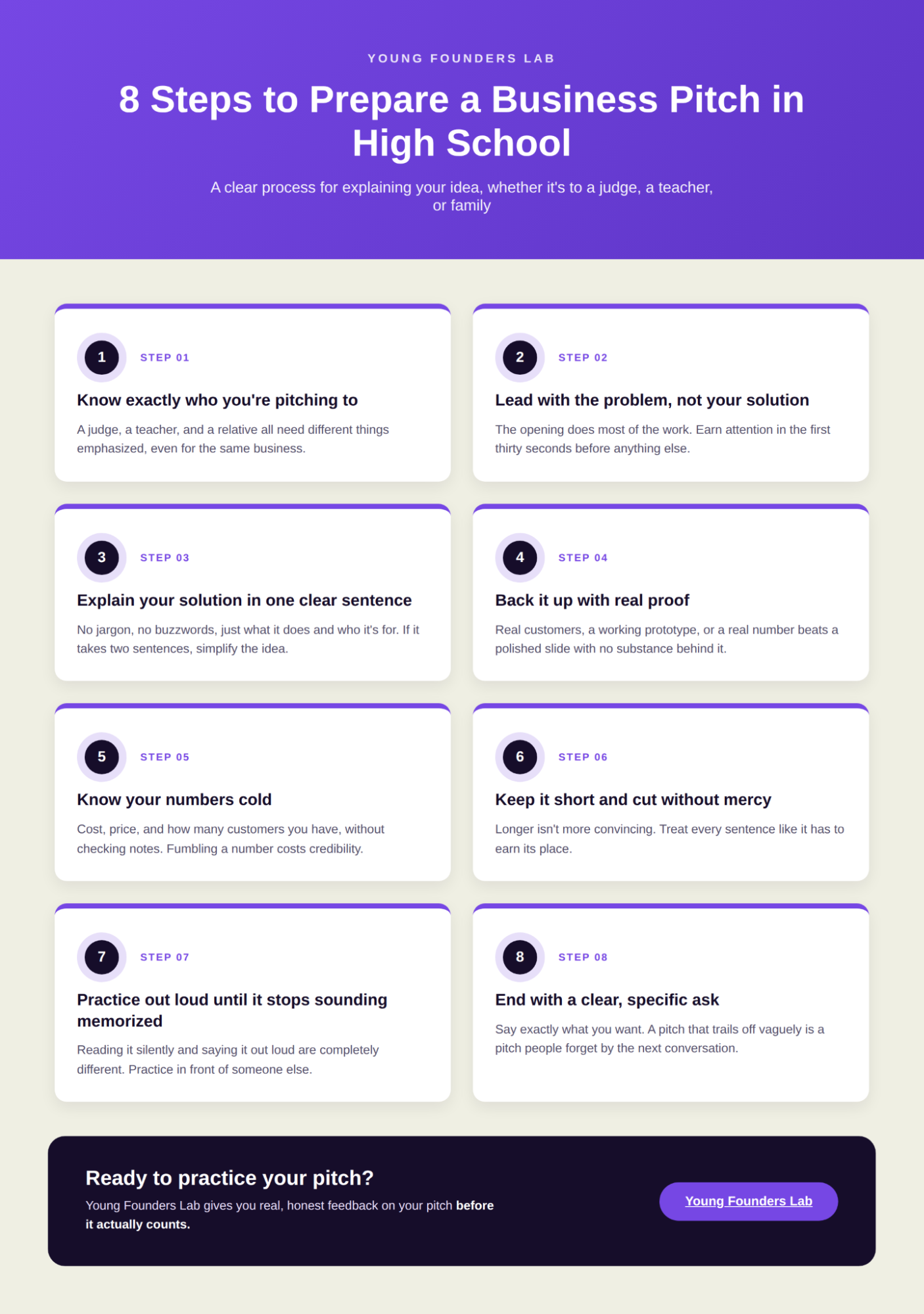
8 Steps to Prepare a Business Pitch in High School
Step 1: Know exactly who you're pitching to
A pitch to a competition panel, a teacher, and a family member all need different things emphasized, even if the business is the same. Judges usually care about market size and whether the idea is well thought out. A relative considering putting in money cares about risk and whether you personally seem reliable. Before writing anything, figure out specifically who's listening and what they actually need to hear to say yes.
Step 2: Lead with the problem, not your solution
Don't open with what you built; open with why it needs to exist. Data from startup fundraising research backs this up more than most people expect: one analysis of how investors actually review pitches found that roughly a third bounce within the first ten seconds of opening a deck, but if you make it past the first few slides, the odds of them sticking around jump sharply. The opening does most of the work. Spend real time on the first thirty seconds of your pitch before worrying about the rest of it.
Step 3: Explain your solution in one clear sentence
Once the problem lands, say what you built in a single, plain sentence. No jargon, no "revolutionary" or "disruptive," just what it does and who it's for. If you need two sentences to explain it, or if a listener has to ask a follow-up question just to understand what you offer, the idea itself needs simplifying before the pitch does.
Step 4: Back it up with real proof
An idea alone doesn't move anyone. A few real customers, a working prototype, or a small but real number, whatever proof you have that this isn't just a theory, matters more than a polished slide. If you don't have much yet, be upfront about that and focus instead on what you've learned so far and what you'd do with the money or support you're asking for.
Step 5: Know your numbers cold
Whatever numbers matter to your business, cost, price, how many customers you have, what a dollar of revenue actually costs you to generate, you need to know them without checking notes. Getting stuck on a number you should know is one of the fastest ways to lose credibility in a pitch, even if the idea itself is strong.
Step 6: Keep it short and cut without mercy
Longer isn't more convincing; it's usually the opposite. Guy Kawasaki's well-known 10/20/30 rule for pitch decks, 10 slides, 20 minutes, 30-point font, has held up for years for exactly this reason; it forces you to cut anything that isn't essential. Research on how investors review pitch decks found the average review takes around two and a half minutes, which means every extra slide or extra minute you add is competing for attention you don't actually have. Whatever you're building your pitch around, treat every sentence like it has to earn its place.
Step 7: Practice out loud until it stops sounding memorized
Reading a pitch silently in your head and saying it out loud are completely different experiences, and the gap between them is exactly where pitches fall apart. Practice it enough times that it sounds natural instead of recited, ideally in front of another person who can ask you questions afterward. The goal isn't to memorize a script word for word; it's to know the material well enough that you could explain it a slightly different way if someone interrupts you.
Step 8: End with a clear, specific ask
Don't let a pitch trail off. Say exactly what you want: a specific dollar amount, a yes or no on a competition entry, feedback on the idea, whatever it actually is, and say it directly instead of hoping the listener infers it. A strong pitch that ends vaguely often gets forgotten by the next conversation. A clear ask is what people actually remember and can act on.
Frequently Asked Questions
1. How long should a business pitch be for a high school competition?
Most competitions specify a time limit, often somewhere between two and five minutes, so check the rules first. Even without a strict limit, shorter is almost always safer; most listeners lose attention well before the five-minute mark.
2. What's the biggest mistake teens make when pitching a business?
Leading with the product instead of the problem is the most common one. If the audience doesn't understand why something matters within the first few seconds, the rest of the pitch has to work much harder to hold their attention.
3. Do I need a slide deck to pitch a business idea?
Not always. Many pitches, especially to family, teachers, or in informal settings, work fine without slides. If a competition requires one, keep it minimal, a handful of slides supporting what you're saying rather than replacing it.
4. Is there somewhere to practice pitching before doing it for real?
Yes. Young Founders Lab gives teen founders structured opportunities to practice pitching in front of mentors and get direct, honest feedback before it actually counts.
P.S. Once your pitch is ready, our breakdown of pitch competitions for high school students is a good next stop if you're looking for somewhere real to actually use it.